Dehumidifiers can feel like a “new” home appliance, the kind you only discover after a damp winter or a frustrating indoor laundry season. But the idea of controlling moisture in the air has been shaping homes, buildings, and everyday comfort for well over a century.
The quick timeline
Here’s the big picture, without the technical rabbit holes:
- Before appliances: people managed dampness with cross-ventilation, heating, and absorbent natural materials.
- Early 1900s: engineers began controlling humidity for industrial problems where moisture ruined paper, textiles, and manufacturing.
- Mid‑century onwards: as mechanical refrigeration became mainstream, residential moisture control became compact, safe, and reliable.
- Late 20th century to now: portable home dehumidifiers became ubiquitous, whisper-quiet, energy-efficient, and effortless to live with.
- Today: dehumidifiers move beyond emergency flood recovery into everyday air comfort, protecting basements, bedrooms, and indoor laundry.

Before machines: How homes tried to manage damp
Long before anyone owned an electric dehumidifier, households shared the same goals: keep rooms feeling fresh, eliminate musty basement odors, and stop moisture from settling where it shouldn’t.
Common traditional approaches included:
- Ventilation (opening windows, encouraging cross-breezes through vents and chimneys)
- Heat (stoves, fireplaces, and steady heating to reduce that cold, clammy feeling)
- Practical routines (drying clothes outdoors on lines, pulling furniture away from cold outside foundation walls)
- Absorbent materials (charcoal, rock salts, and later chemical desiccants used in closets, pantries, and storage chests)
These methods helped intermittently, but they depended completely on weather and drafty building designs. As modern architecture sealed homes tightly, families needed consistent, automated moisture extraction.
Image credit: Medium
The early 1900s breakthrough: Humidity control becomes 'a thing'
One of the most consequential leaps in humidity control didn’t start in a house—it started in a Brooklyn printing plant in 1902.
A New York publishing company struggled with an exasperating problem: when summer humidity soared, printing paper absorbed moisture and expanded. When the air dried out, paper shrank. This caused four-color ink alignments to misalign completely, ruining print runs. Young engineer Willis Carrier designed a mechanical system using chilled coils that cooled air down to its dew point, wringing moisture out before reheating the air.
That invention fundamentally changed modern life: it formalized the understanding that comfort and indoor air quality depend just as much on relative humidity as on ambient temperature. Controlling airborne water vapor became a science.
Image credit: Smithsonian Institution
From factories to living rooms: The rise of residential dehumidifiers
For decades, mechanical humidity control remained confined to textile mills, pharmaceutical labs, and commercial printing houses—places where moisture damage ruined valuable inventory.
Following World War II, the rapid miniaturization of refrigeration compressors and electric fan blowers brought humidity control into residential homes. Homeowners across North America discovered that portable dehumidifiers could transform damp, unlivable basements and cellars into usable living rooms and workshops.
What didn’t change were the everyday moisture triggers:
- Hot showers, cooking steam, and dishwashers
- Drying clothes indoors during cold or wet seasons
- Poor airflow in below-grade basements and crawl spaces
- Humid subtropical summer air masses across the Midwest, South, and East Coast
The critical difference was that moisture control no longer relied on guesswork or open windows. An automatic machine could quietly run in the corner, capturing water before mold spores took hold.
Two paths, one goal: Compressor vs desiccant
Modern moisture-control devices rely on two primary technologies, both designed for the exact same objective: lower airborne humidity.
Compressor dehumidifiers:
The most popular and cost-effective system for residential homes and basements. A fan draws moist air across refrigerated metal coils; moisture condenses into water droplets and drains into a collection bucket, while warm, dry air is recirculated into the room.
Desiccant dehumidifiers:
Instead of condensing water on cold coils, desiccant systems pass air through moisture-absorbing materials (such as silica gel or specialized mineral salts). Non-electric consumer versions—like our calcium chloride Osmo® moisture absorbers—capture moisture silently in closets and pantries without electricity. Industrial desiccant units are also used in unheated commercial freezers and cold facilities.
You don’t need to get bogged down in engineering jargon. Simply assess your space: room square footage, temperature range, and where moisture accumulates.
The modern dehumidifier: Quieter, smarter, easier to live with
Today’s dehumidifiers are engineered specifically for living spaces, not just damp utility closets.
Key advancements in modern dehumidifier technology include:
- Digital LED touch controls and precise built-in humidistats that cycle off automatically
- Ultra-efficient rotary compressors and whisper-quiet decibel levels suitable for bedrooms
- Convenient features tailored to busy households: 24-hour timers, auto-shutoff safety switches, continuous gravity drainage ports, and washable filters
The finest home appliances operate seamlessly in the background: reliable, reassuring, and unobtrusive. Your home simply stays comfortable and smells clean.
Why dehumidifiers are more essential than ever
If dehumidifiers have existed for a century, why are they seeing unprecedented household adoption today?
Because modern building methods create modern moisture dynamics:
- Tightly sealed, energy-efficient building envelopes that trap humidity indoors
- Urban apartments and condos where opening windows lets in noise, pollution, or summer humidity
- Increased indoor clothes drying on racks to conserve electricity
- Greater awareness of indoor air quality, mold allergies, and respiratory health
Dehumidifiers have transitioned from emergency flood tools to essential year-round household appliances for total home wellness.
Not just a fix: Dehumidifiers as everyday air comfort
You don’t have to wait for standing water or peeling paint to appreciate a dehumidifier.
For thousands of families, regular humidity control delivers tangible daily upgrades:
- Living rooms feel lighter and noticeably less muggy
- Bedrooms feel cooler and more comfortable for sound sleep
- Bathrooms dry out rapidly after hot showers, preventing grout mildew
- Indoor laundry dries in hours rather than days without musty odors
It is comfort you can feel every single day. That is why modern households run their dehumidifier quietly on auto, maintaining a healthy 45%–50% humidity baseline.
How to choose a dehumidifier (using history as your guide)
Understanding the history helps clarify what matters most when selecting a unit:
Evaluate these five practical factors:
-
Where is the moisture? Basement, crawl space, bathroom, walk-in closet, or laundry room.
-
What is the room size? Match capacity: compact mini units for up to 250 sq ft; 50 Pint/Day models for up to 2,000 sq ft.
-
What is the ambient temperature? Compressor units operate with maximum efficiency in standard indoor environments above 41°F (5°C).
-
How hands-off do you want to be? Select models with large tanks or continuous gravity drainage ports.
-
Does noise matter? Look for decibel ratings under 45 dB for bedrooms and living spaces.
A quality dehumidifier should simplify your life, not add another chore.
Common myths (quick clarifications)
Several persistent myths prevent homeowners from enjoying the benefits of a dehumidifier:
“Dehumidifiers are only for severe mold problems”
They are equally valuable for everyday comfort, allergy relief, laundry drying, and basement moisture prevention.
“A dehumidifier will make the air too dry”
Modern humidistats let you select your ideal setpoint (usually 45%–50%), automatically shutting off before air becomes overly dry.
“A dehumidifier is just an air purifier”
They perform completely different jobs: air purifiers capture airborne particles and pollen, while dehumidifiers extract excess water vapor.
“They are complicated to operate”
Contemporary units are plug-and-play: set your target humidity, press power, and let the automatic sensors manage the rest.
“Humidity is only a summer problem”
Winter cooking, hot showers, and sealed windows create substantial winter condensation and dampness.
FAQs
When was the first mechanical dehumidifier invented?
Engineered humidity control was pioneered in 1902 in New York by Willis Carrier to stabilize paper in printing presses, paving the way for both modern air conditioning and dedicated dehumidifiers.
Is a dehumidifier the same as an air conditioner?
While both utilize refrigeration compressors, an air conditioner exhausts heat outside to drop room temperature, whereas a dehumidifier concentrates solely on extracting water vapor and draining it away.
Where do dehumidifiers work best in a home?
They excel anywhere damp air settles: below-grade basements, laundry rooms, bathrooms without exterior exhaust fans, and rooms where window condensation occurs.
Do I need a dehumidifier if my house feels fine?
Many households run a dehumidifier for preventive comfort: stopping hidden mold growth inside closets, keeping basements smelling fresh, and accelerating laundry drying.
The takeaway
Dehumidifiers didn’t appear overnight. They are the result of more than a century of scientific innovation in controlling how moisture impacts building integrity, human comfort, and everyday wellbeing.
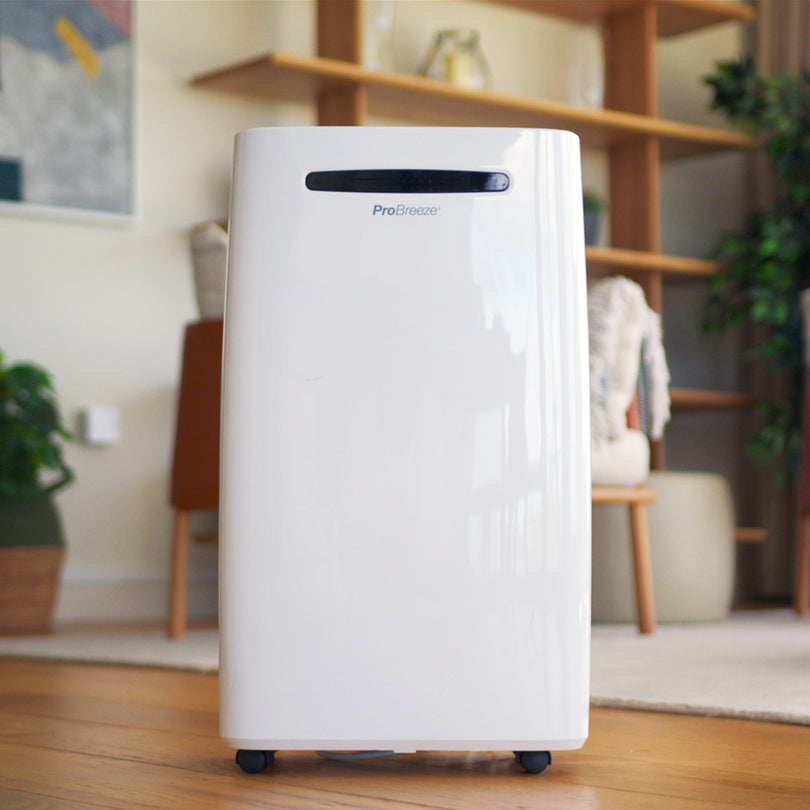
Today, they are no longer cumbersome industrial contraptions. Modern Pro Breeze dehumidifiers are sleek, quiet, energy-efficient appliances that keep your home healthy and comfortable.

Osmo® 2.3 pt Moisture Absorber with 25 oz Tablet - White
$34.00
View details