

The quick answer
- Will it stop condensation? Yes. Condensation forms when warm, humid air hits cold windowpanes and uninsulated walls. A dehumidifier extracts that moisture from the air so water cannot collect on glass and sills.
- Does it get rid of mold? It stops mold from returning by removing the dampness it needs to survive. Clean off existing mold spots first, then maintain indoor humidity below 50% to prevent spores from recolonizing.
- What humidity: set your humidistat to 30–50% (30–40% in winter, up to 50% in summer). Mold growth accelerates rapidly above 50% relative humidity.
- Where to put it: place it close to the condensation problem, but keep at least 8 inches (20 cm) of clear space around vents. If bedroom windows mist up, a quiet model with a built-in humidistat can help control room humidity.
- Which size: a compact mini model (up to 250 sq ft) for bedrooms, bathrooms, and closets; choose a 50 pint/day model for basements, living rooms, and whole apartments. See the room-by-room plan.

Waking up to dripping windows, damp sills, and black mold spreading behind dressers is a frustrating reality in many homes. Left unchecked, excessive moisture damages window frames, stains drywall, and exacerbates allergies and respiratory issues. A dehumidifier directly resolves the problem by pulling gallons of water out of the air before it can condense. Here is exactly how to eliminate condensation and stop mold for good.
1Will a dehumidifier stop condensation?
Yes, absolutely. Condensation happens when warm, moisture-laden indoor air makes contact with cold surfaces—most noticeably window glass, exterior walls, and metal frames. As the air cools against the cold glass, it reaches its dew point and drops excess water vapor as liquid droplets.
A dehumidifier continuously draws in humid air, condenses the water vapor into an internal reservoir, and blows dry, slightly warmed air back into the room. By bringing ambient relative humidity below the dew point, the moisture simply stays dissolved in the air rather than condensing onto your windows and walls.
2Does a dehumidifier get rid of mold?
A dehumidifier stops mold from growing and spreading, but it does not magically wipe away dead spores already clinging to surfaces. Mold requires three elements to thrive: moisture, warmth, and organic matter (such as wallpaper paste, drywall paper, wood, or dust). By eliminating excess moisture, you remove the life support mold needs to multiply.
To deal with mold permanently, use this two-step approach:
- Clean off existing mold: wear gloves and an N95 mask, and clean affected surfaces thoroughly with an EPA-registered mold disinfectant or warm soapy water. Avoid dry brushing, which sends millions of spores airborne.
- Run a dehumidifier: keep indoor humidity consistently below 50% (and between 30–40% during freezing winter weather) so dormant spores cannot reactivate.

3What causes condensation and mold in homes?
Everyday family activities add massive volumes of water vapor to household air. In weather-sealed modern homes or closed-up winter houses, that moisture becomes trapped indoors:
| Daily activity | Moisture added to air |
|---|---|
| Normal breathing (family of four) | 4–6 pints (2–3 quarts) per day |
| Cooking, dishwashing, and boiling water | 2–6 pints (1–3 quarts) per day |
| Showers and hot baths | 2–4 pints (1–2 quarts) per day |
| Drying a load of laundry indoors | 4–6 pints (2–3 quarts) per load |
Altogether, an average household releases up to 20 to 28 pints of water into indoor air every single day. Without active mechanical ventilation or a dehumidifier, that airborne water relentlessly condenses onto the coldest spots in your home.
4What humidity should I set my dehumidifier to?
The optimal indoor relative humidity is 30–50% in summer and 30–40% in winter. The U.S. Environmental Protection Agency (EPA) recommends maintaining indoor relative humidity below 50% (and ideally between 30% and 50%) to prevent mold growth and dust mite infestations.
| Relative humidity | Status | Action needed |
|---|---|---|
| Below 30% | Too dry | Can cause dry skin, irritated sinuses, and static electricity. Turn down the dehumidifier or run a humidifier. |
| 30–50% | Ideal | Target zone: set your humidistat to maintain this level (30–40% in cold weather, 40–50% in warmer months). |
| 50–60% | Mold threshold | Mold spores can begin germinating. Turn on your dehumidifier and adjust setting to 45–50%. |
| 60–70% | High condensation risk | Windows fog heavily; runs of water form on sills. A bedroom dehumidifier helps lower the humidity that causes window condensation. |
| Above 70% | Severe mold hazard | Mold spreads aggressively on organic materials. Run dehumidifier continuously and inspect for plumbing or foundation leaks. |
Cold exterior walls and window corners can still feel chilly below 50%, so place your dehumidifier nearby to circulate dry air into cold corners.
5Where to put a dehumidifier for condensation
Placement makes a tremendous difference to how effectively your dehumidifier pulls moisture from the air:
- Near the moisture source: Place it near the streaming windows, damp basement wall, or in the laundry room where moisture originates.
- Maintain airflow clearance: Keep at least 8 inches (20 cm) of open space around all sides so airflow into grilles and out of exhaust louvers is unrestricted.
- Central landing or hallway: To treat multiple upstairs bedrooms, position the dehumidifier centrally on the landing with bedroom doors propped open during the day.
- Never block with furniture: Do not tuck the appliance behind drapes, headboards, or sofas where stagnant pockets of humid air can linger.
6How much water should a dehumidifier collect?
When you first turn on a dehumidifier in a damp room, it may fill its water reservoir in a matter of hours. This is completely normal: the machine is not just drawing water from the air, but also drawing out moisture deeply absorbed into carpets, mattresses, drywall, and wooden framing.
After a few days of continuous operation, extraction rates will naturally taper off as the room reaches an equilibrium. At that point, the dehumidifier will cycle off automatically via its humidistat, turning on only when new moisture is introduced.
7Room-by-room plan
Different areas of your home face unique moisture challenges. Match your dehumidifier capacity to the room:
Bedrooms
Overnight respiration releases pints of water while you sleep, making bedrooms the prime location for fogged windows and mildew behind headboards and closets. You need whisper-quiet operation. The 1200 Cu. Ft. Mini Dehumidifier handles small bedrooms and dorms up to 205 sq ft, while the 2200 Cu. Ft. Mini Dehumidifier covers up to 250 sq ft with a 52 oz tank.
Bathrooms
Hot showers flood bathrooms with dense steam, fogging mirrors and fostering pink slime and black mildew along grout lines. Run your exhaust fan during showers, then let a compact dehumidifier like our 2200 Cu. Ft. Mini Dehumidifier pull lingering dampness from the air to keep towels fresh and walls dry.
Living rooms, apartments, and basements
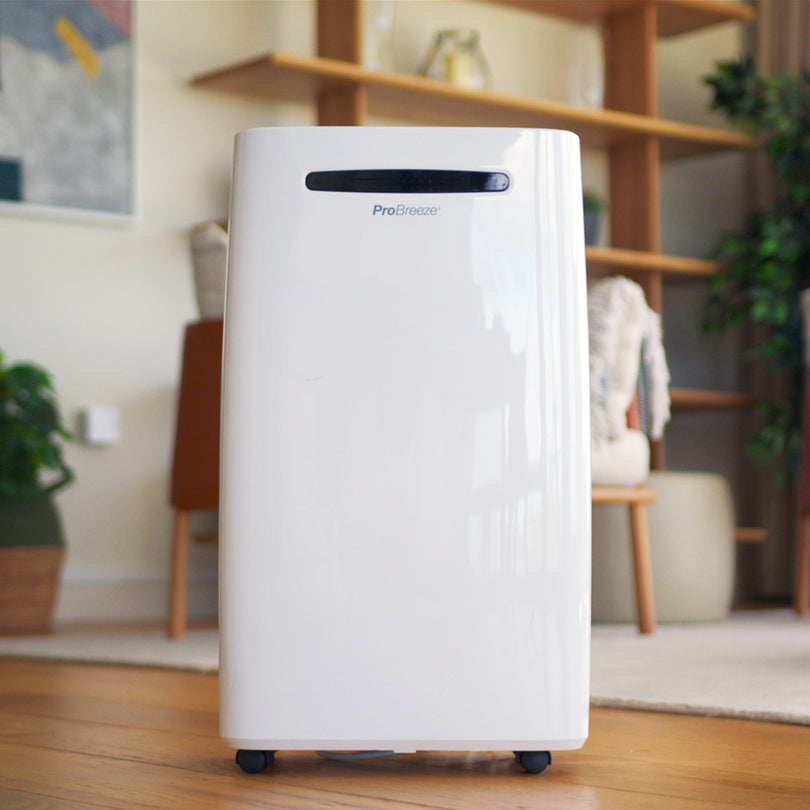
For open living areas, finished basements, or main floors of a house, you need substantial extraction capacity. The 50 Pint/Day Dehumidifier covers up to 2,000 sq ft, removing up to 50 pints of moisture every 24 hours. Its continuous drainage port allows you to run a hose directly to a floor drain or sump pit.
Unheated garages, workshops, and cold spaces
Standard compressor dehumidifiers lose efficiency in cold spaces below 59°F (15°C). For unheated garages, workshops, or cold crawl spaces down to 34°F (1°C), a specialized desiccant dehumidifier prevents coil frost and maintains reliable moisture extraction.
Closets, pantries, and RVs
Enclosed spaces lacking active airflow need compact moisture defense: our 52 Ounce Mini Dehumidifier or an electricity-free Osmo® 2.3 pt Moisture Absorber protects clothing, shoes, pantry goods, and RV interiors from musty odors.
| Space | Room size | Recommended model |
|---|---|---|
| Small bedroom, dorm room, nursery | Up to 205 sq ft | 1200 Cu. Ft. Mini Dehumidifier |
| Master bedroom, bathroom, laundry room | Up to 250 sq ft | 2200 Cu. Ft. Mini Dehumidifier |
| Basement, open living area, apartment | Up to 2,000 sq ft | 50 Pint/Day Dehumidifier |
| Unheated garage, cold crawl space | Cold spaces under 41°F | Desiccant dehumidifier |
| Closet, pantry, RV, storage cabinet | Enclosed tight spaces | Mini Peltier or Osmo® Moisture Absorber |
Still weighing your options? Read our 13-step guide to buying a dehumidifier for detailed sizing and feature advice.
8Condensation absorbers, damp traps and tablets vs a dehumidifier
Disposable moisture absorber tubs and refillable tablet systems (like our Osmo® moisture absorber) work through passive chemical absorption. They require no electricity, making them ideal for enclosed closets, kitchen pantries, gun safes, and seasonal RV storage. However, they extract small amounts of water over weeks, making them unable to tackle the high moisture volumes of full rooms. For living spaces, bedrooms, and basements, an electric dehumidifier is essential.
Compare both options in our detailed guide: moisture absorbers vs dehumidifiers.
9Other quick fixes that help
- Run exhaust fans: keep bathroom and range hood exhaust fans running during use and for 15 minutes afterward.
- Cover cooking pots: trapping steam while boiling food prevents quarts of vapor from escaping into living areas.
- Dry laundry properly: avoid drying wet laundry on airers in closed living rooms without a dehumidifier running nearby. See our guide to drying clothes indoors with a dehumidifier.
- Seal drafts and gaps: check exterior doors and windows for drafts that chill glass and interior surfaces.
10Best Pro Breeze dehumidifiers for condensation and mold

50 Pint/Day Dehumidifier - 2,000 Sq Ft Dehumidifiers for Home with Continuous Drainage
$189.99
View details
Browse our complete lineup on the Pro Breeze dehumidifiers page to find the ideal match for your home.
11Frequently asked questions
How long does a dehumidifier take to stop condensation?
You will typically see a noticeable improvement on window glass within 24 to 48 hours. During the first few days, the machine extracts stored dampness from walls, rugs, and furniture. Once relative humidity stabilizes below 50%, windows will remain clear day to day.
What helps reduce condensation in a bedroom?
Moisture from breathing can build up in a closed bedroom. Compact models rated at 33–38 dB provide quiet moisture removal, and the humidistat can cycle the unit as needed to maintain a 40–50% target. Follow the instructions in your product’s manual.
What size dehumidifier do I need for a 3-bedroom home?
Size by square footage and problem severity rather than bedroom count alone. A 50 Pint/Day unit covers up to 2,000 sq ft, making it ideal for finished basements or open main floors. If high humidity is confined to specific bedrooms or bathrooms, placing dedicated mini dehumidifiers in those rooms often provides quieter, more targeted relief.
Will a dehumidifier help with damp walls?
Yes, if the dampness is caused by condensation, which is the most frequent culprit. However, if moisture stems from leaking plumbing, foundation seepage, or roof leaks, the source must be repaired first. The dehumidifier will then accelerate drying the structure thoroughly.
I rent. What can I do about condensation and mold?
Ventilate bathroom and kitchen steam, avoid air-drying damp laundry indoors without a dehumidifier, and keep indoor humidity between 30–50%. Document visible mold growth, peeling paint, or leaks and notify your landlord or property management company in writing promptly. Most tenant protection ordinances require landlords to maintain watertight structures and repair plumbing defects.
With the right size dehumidifier set to 30–50%, you can keep windows dry, walls clean, and your indoor air healthy. Explore our full range of dehumidifiers, and learn more in our guide to treating and preventing damp in your home.


