

In this article, we’ll explain how commercial dehumidifiers work, explore the signs that your facility needs an upgrade from a standard residential unit, discuss the benefits of high-capacity moisture extraction, and explain the differences between commercial compressor and commercial desiccant technologies.
Why a Standard Dehumidifier Isn’t Always Enough
Residential mini dehumidifiers are exceptional for bedrooms, closets, and small offices. But when dealing with expansive commercial floor plans, towering ceilings, or harsh industrial environments, standard consumer units often fall short. Here are common limitations of standard units in commercial settings:
- Limited extraction capacity – They struggle to remove sufficient pints of water per day across vast square footage.
- Insufficient airflow (CFM) – Smaller blower fans cannot circulate air effectively across wide open warehouses or tall pallet racks.
- Shorter continuous duty cycles – Compact residential units are not engineered for continuous 24/7 heavy-duty operation, leading to premature motor wear.
- Manual drainage constraints – Commercial applications demand reliable continuous gravity drainage or built-in condensate pumps rather than constantly emptying small buckets.
Signs of Excess Humidity in Commercial Spaces
Before choosing a moisture control solution, identify the warning signs of elevated relative humidity in your facility:
- Sweating concrete floors, fogged windows, or condensation pooling on exterior walls
- Warping wooden pallets, rusting structural steel, or visible mold growth
- A persistent musty, stale odor across inventory aisles
- Increased airborne allergens and respiratory discomfort reported by employees
- Sensitive electronic or automated equipment malfunctions caused by moisture
- Soggy corrugated packaging, degraded paper records, or ruined stock
- Skyrocketing energy utility bills caused by overworked commercial HVAC systems
Any of these red flags indicates that passive ventilation is failing and that an industrial-grade dehumidification solution is required.
How Do Commercial Dehumidifiers Work?
At their core, all dehumidifiers draw in damp air, extract the suspended water vapor, and discharge drier, warmed air back into the room. Commercial dehumidifiers differentiate themselves through heavy-duty engineering, higher airflow (CFM), ruggedized housings, and advanced moisture-removal coils designed for continuous operation.
The Basic Process:
-
Air Intake: A high-velocity commercial blower fan pulls large volumes of humid air through heavy-duty intake grilles.
-
Moisture Extraction: In a refrigerant-based compressor unit, the air streams across refrigerated coils chilled below the dew point, causing moisture to condense rapidly into liquid droplets. In a commercial desiccant unit, air passes through a slowly rotating silica-gel desiccant wheel that physically adsorbs moisture from the air.
-
Water Removal: Condensed water collects in an internal basin and is immediately pumped or gravity-drained away through a continuous drainage hose to a floor drain or sump.
-
Air Reheating and Discharge: The dehumidified air passes across condenser reheat coils, expanding slightly before blowing back into the facility as warm, dry air.
This cycle runs continuously, rapidly driving relative humidity down to safe commercial levels (typically 40–50%).

Commercial Compressor vs. Commercial Desiccant Dehumidifiers
Choosing the right industrial dehumidifier depends primarily on your ambient operating temperatures:
1. Refrigerant Compressor Dehumidifiers
- Operate at peak efficiency in ambient temperatures above 59°F (15°C)
- Ideal for warehouses, commercial gyms, retail showrooms, and finished basements
- Highly energy-efficient in warm, high-humidity environments
2. Commercial Desiccant Dehumidifiers
- Engineered specifically for chilly environments below 50°F (10°C) down to near-freezing
- Essential for refrigerated food storage, unheated storage facilities, and winter job sites
- Maintains low dew points regardless of extreme ambient temperature drops
Desiccant units utilize a heated ceramic rotor that bakes out trapped moisture, allowing them to extract moisture from freezing air where compressor cooling coils would simply freeze into solid ice.
Benefits of Using a Commercial Dehumidifier
Deploying commercial-grade moisture control protects your bottom line across multiple fronts:
- Protects Inventory: Prevents mold, rot, and spoilage of sensitive inventory, including cardboard packaging, lumber, textiles, and electronic parts.
- Preserves Structural Integrity: Prevents structural corrosion, concrete sweating, and dry rot in framing and drywall.
- Improves Facility Air Quality: Dramatically reduces airborne mold spores, dust mites, and musty warehouse odors.
- Maximizes HVAC Efficiency: Dry air takes far less energy to heat and cool, easing the load on rooftop HVAC systems and cutting utility bills.
- Boosts Workplace Productivity: Provides a fresher, healthier, and safer environment for warehouse staff, technicians, and customers.
Choosing the Right Pro Breeze Dehumidifier for Your Space
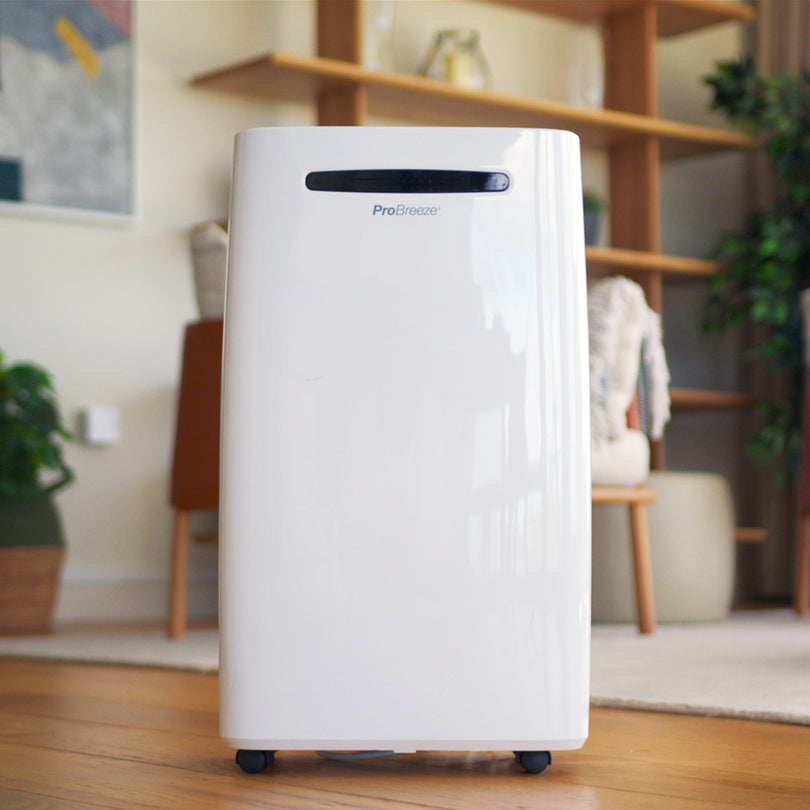
For large residential basements, light commercial facilities, storage units, and workshops up to 2,000 sq. ft., the Pro Breeze 50 Pint/Day Dehumidifier with Continuous Drainage provides heavy-duty moisture control. It includes professional features such as:
- High-capacity extraction of up to 50 pints per day
- Continuous drainage port with an included hose that directs collected water to a suitable drain
- Digital humidistat and 24-hour programmable shut-off timer
- Automatic defrost system for operation in cooler spaces
- Heavy-duty caster wheels and integrated carry handles for easy mobility
- Automatic shut-off when the reservoir reaches capacity
Explore our full lineup on the Pro Breeze Dehumidifiers Range for complete specifications. Sizing a unit for your home or workshop? Read our 13-step guide to buying a dehumidifier for comprehensive sizing advice.
Conclusion
Understanding how commercial dehumidifiers work is the first step toward safeguarding your facility, inventory, and employees from moisture damage. When large spaces or severe dampness demand more than a compact room unit can provide, a high-capacity dehumidifier with continuous drainage makes a world of difference.
Protect your building and equipment from corrosion, condensation, and mold. Equip your workspace with high-efficiency dehumidification from Pro Breeze and keep your air clean, dry, and healthy.


