

The quick answer
- The 3 main types: Compressor (refrigerant) for everyday rooms, basements and laundry; Desiccant (absorbent wheel) for colder spaces; and Thermoelectric (Peltier/mini) for closets and bathrooms.
- How they work: all dehumidifiers pull humid air in, extract moisture into a water tank or drain hose, and release drier air back into the room.
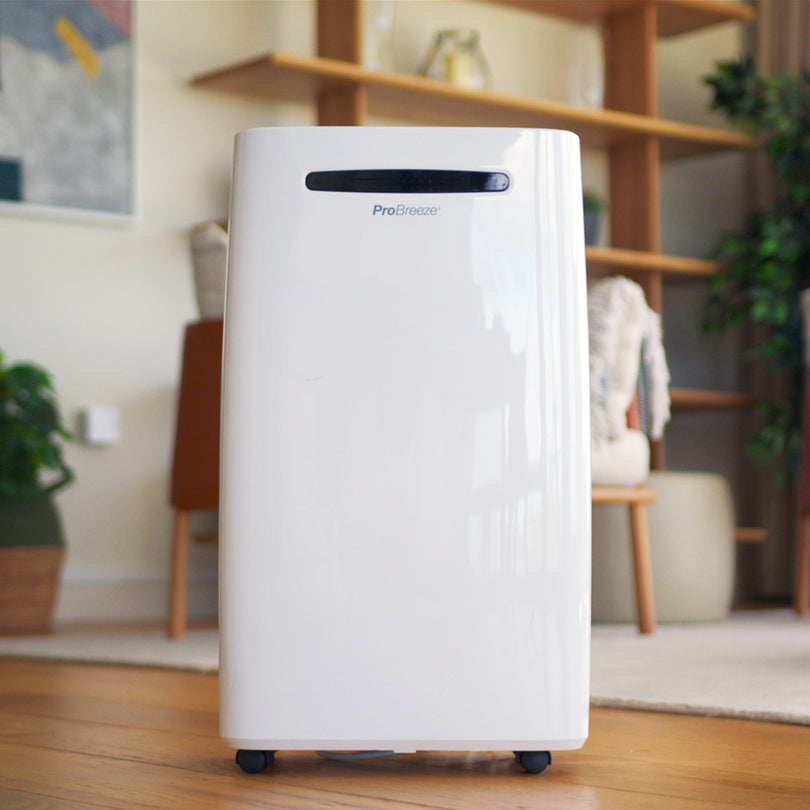
- Which to choose: for living areas, basements, and laundry drying, a compressor model like our 50 Pint/Day Dehumidifier delivers the highest extraction. For closets, cabinets, or small bathrooms, a mini Peltier unit is ideal.
- See how to choose.

If you’ve started looking for a dehumidifier, you’ll notice something quickly: not every dehumidifier is built the same. Some are designed for everyday rooms and basements, some work in cooler spaces, and some are small mini units made for closets and tight areas. The good news? Once you understand the basics, choosing the right type becomes simple. In this guide, we’ll explain the main types of dehumidifiers in plain English—how each one works, where it performs best, and how to pick the right model for your home.

1What all dehumidifiers have in common
Whatever the type, the basic idea is the same: air goes in, water comes out.
A fan pulls humid air into the unit. The dehumidifier removes water vapor from the airflow, collecting it in an internal tank or draining it continuously through a hose. The drier, treated air is then circulated back into the room.
Many dehumidifiers also feature an integrated humidistat (humidity sensor) that automatically maintains your chosen comfort level—turning the unit into an effortless helper in the background rather than another household chore.

2Compressor (refrigerant) dehumidifiers: how they work & best uses
Compressor dehumidifiers remove moisture by chilling the air, operating similarly to a household refrigerator:
- A fan pulls warm, humid room air into the unit.
- The air passes across cold refrigerated coils.
- Moisture rapidly condenses into water droplets on the cold coils (like condensation forming on an iced drink).
- The liquid water drips down into the reservoir tank or drains through a hose.
- The dry air passes over a warm condenser and is gently released back into the room.
This design is why compressor dehumidifiers are the most popular choice for homes: they are highly energy-efficient and extract substantial volumes of moisture (up to 50 pints per day) under standard indoor conditions.
Best for: everyday rooms, basements, and laundry
A compressor dehumidifier is usually the best all-around choice for:
- Bedrooms, living rooms, and finished basements
- Laundry rooms for accelerated, damp-free clothes drying
- Kitchens, hallways, and open-plan living spaces
- Homes dealing with window condensation, mold spots, or muggy air
Our top North American recommendation is the 50 Pint/Day Dehumidifier with Continuous Drainage, covering spaces up to 2,000 sq ft.

3Desiccant dehumidifiers: how they work & best uses
Desiccant dehumidifiers extract moisture by chemical absorption rather than cooling coils.
Instead of a compressor and refrigerant, they utilize a slowly rotating wheel coated with a moisture-absorbing desiccant material (such as silica gel). As humid air passes through the wheel, moisture is absorbed. An internal heater warms a secondary airflow to dry the wheel, condensing the extracted moisture into a collection tank.
Because desiccant dehumidifiers do not rely on refrigerated coils, they can operate effectively in near-freezing temperatures where compressor coils would frost over. However, desiccant models draw considerably more electricity due to their internal heating element. Note: Pro Breeze does not offer desiccant models in North America; our compressor models are rated to operate efficiently down to 41°F (5°C), which handles typical basement and garage conditions.

4Thermoelectric (Peltier) mini dehumidifiers: how they work & best uses
Mini dehumidifiers use solid-state thermoelectric technology (also known as the Peltier effect). Instead of a heavy motor or compressor, an electric current passes between two distinct semiconductors, creating one cold surface and one warm surface. Humid air is drawn across the cold plate, where moisture condenses and drips into a compact tank.
Peltier units offer unique advantages:
- Whisper-quiet: with no compressor vibrations, only a small fan produces sound (< 40 dB)
- Ultra-low power draw: consumes only 22W to 40W, costing less than 1¢ an hour
- Compact & lightweight: easily fits onto desks, shelves, or closet floors
While mini dehumidifiers cannot treat large rooms or damp basements, they are unbeatable for closets, pantries, RVs, shoe cabinets, and small bathrooms. Explore our 52 Ounce Mini Dehumidifier or 17 Ounce Mini Dehumidifier.
5What about whole-house dehumidifiers?
Whole-house dehumidifiers are centralized units connected directly into your home's central HVAC ductwork. They provide balanced humidity control across every room simultaneously. However, they require substantial upfront investment (often thousands of dollars) and professional installation.
For most households, portable dehumidifiers offer the ideal combination of affordability, flexibility, and targeted control: you can position the appliance directly where moisture is highest, such as next to laundry racks or in the basement.
6How to choose the right type: a simple decision guide
Start with two questions: what size is the space, and how cold does the area get?
| Your space & conditions | Recommended dehumidifier type | Our pick |
|---|---|---|
| Whole basement, living room, or family laundry (up to 2,000 sq ft) | Compressor dehumidifier | 50 Pint/Day Dehumidifier |
| Closet, bathroom, pantry, or RV (up to 250 sq ft) | Thermoelectric mini dehumidifier | 52 Ounce Mini Dehumidifier |
| Enclosed cabinet or drawer without an electrical outlet | Non-electric moisture absorber | Osmo® 2.3 pt Absorber |
Key features to check before purchasing: room coverage, daily extraction capacity (in pints per day), digital humidistat, auto shut-off, and continuous drain capability.

7How to use any dehumidifier well (3 quick tips)
- Position where moisture originates: place the unit in your laundry area, basement center, or moisture-prone room.
- Keep windows and exterior doors closed: running a dehumidifier with windows open draws in outdoor humidity rather than drying your indoor air.
- Provide adequate clearance: keep at least 8 to 12 inches of open space around air intakes and outlets so airflow is never restricted.
On models with continuous drainage, a hose directs collected water to a suitable floor drain or sump pump, so there is no bucket to empty. Follow the instructions in your product’s manual.
8Frequently asked questions
Which type of dehumidifier is best for a basement?
A compressor dehumidifier with high daily extraction and continuous drainage is the gold standard for basements. Our 50 Pint/Day model handles spaces up to 2,000 sq ft and operates down to 41°F (5°C).
Do mini thermoelectric dehumidifiers really work?
Yes, within their intended scope. They are designed for enclosed spaces such as closets, pantries, and small bathrooms. For open rooms or heavy condensation, choose a full-size compressor model.
Which type of dehumidifier is cheapest to run?
Mini thermoelectric units use the least electricity (22W–40W, under 1¢ per hour), but compressor models deliver vastly more moisture removal per watt, making them the most cost-effective per pint of water extracted.
Can a dehumidifier help dry laundry?
Yes. Placing a compressor dehumidifier in a closed room next to a drying rack cuts drying time roughly in half while preventing damp air from settling on walls and windows.
Choosing the right dehumidifier ensures your home stays comfortable, fresh, and protected against moisture damage. Explore our complete dehumidifiers collection to compare models, or read our guide on how much a dehumidifier costs to run.


