

The quick answer
- Pro Breeze dehumidifiers cost about 0.4¢ to 7.6¢ an hour at full power, based on the US national residential electricity average of 18.16¢ per kWh (US EIA, August 2026). Compact mini models cost under 1¢ an hour, while our high-capacity 50 Pint/Day compressor model costs about 7.6¢ an hour.
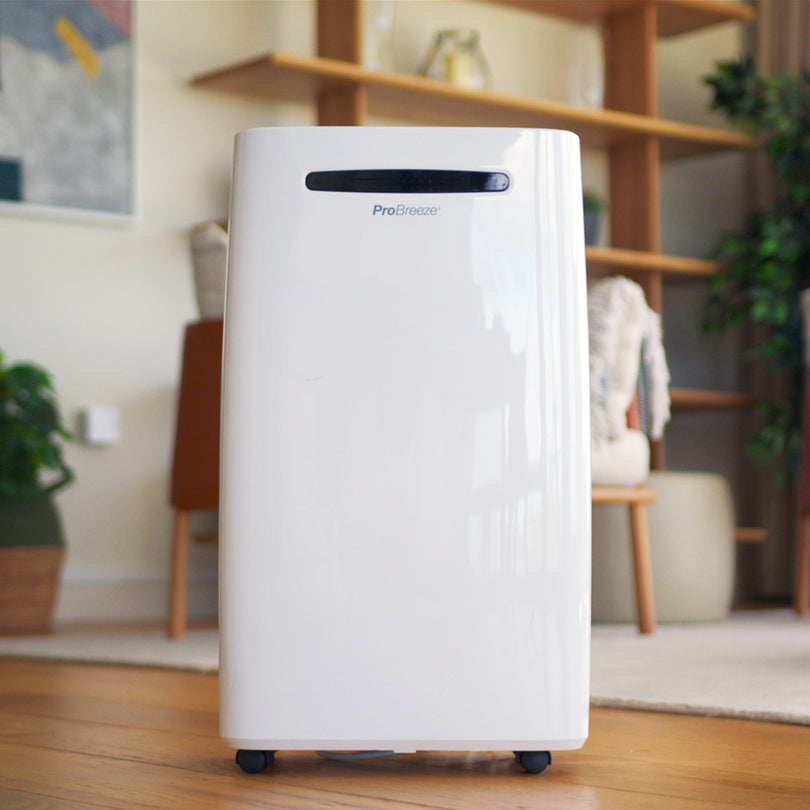
- The 50 Pint/Day Dehumidifier costs about 7.6¢ an hour: roughly 61¢ for an 8-hour session, or about $18.31 for 30 eight-hour days.
- Real costs are usually lower: built-in digital humidistats automatically switch the compressor off once the room reaches your target humidity.
- Cost per pint removed: our 50 Pint/Day compressor model extracts moisture for only about 3.7¢ per pint (approx 29¢ per gallon), making it exceptionally cost-effective.
- See the running cost by model.

How much does a dehumidifier cost to run? Far less than most homeowners imagine. A modern energy-efficient dehumidifier uses roughly the same electrical power as a couple of LED light fixtures or a small desktop computer, yet it can pull pints of water out of your indoor air every day. That means drier basements, fresher laundry, reduced musty odors and zero condensation on windows—all for pennies a day. Here is the realistic cost breakdown for Pro Breeze dehumidifiers based on current US electricity prices.
1Dehumidifier running costs by model (US)
All calculations assume the dehumidifier runs continuously at its rated wattage from Pro Breeze product specifications. Monthly calculations assume 8 hours of daily operation across 30 days. The final column shows the cost per pint of water extracted at maximum rated capacity: (kW × 18.16¢ × 24 hours) ÷ pints per day.
| Model | Power | Per hour | Per 8 hours | Per month (8 h/day) | Cost per pint removed |
|---|---|---|---|---|---|
| 1200 Cu Ft Electric Mini | 20 W | 0.4¢ | 2.9¢ | $0.87 | 65.4¢ |
| 17 Ounce Mini Dehumidifier | 22 W | 0.4¢ | 3.2¢ | $0.96 | 57.5¢ |
| 2200 Cu Ft Compact Mini | 40 W | 0.7¢ | 5.8¢ | $1.74 | 38.7¢ |
| 52 Ounce Premium Mini | 40 W | 0.7¢ | 5.8¢ | $1.74 | 38.7¢ |
| 3 Pint Dehumidifier | 60 W | 1.1¢ | 8.7¢ | $2.61 | 8.7¢ |
| 50 Pint/Day Compressor Dehumidifier | 420 W | 7.6¢ | 61.0¢ | $18.31 | 3.7¢ |
Figures calculated at full rated power using the US national average residential electricity rate of 18.16¢ per kWh (US Energy Information Administration (EIA), August 2026). Utility rates vary widely by state and province (e.g. lower in the Northwest, higher in California and the Northeast). Digital humidistats cycle the compressor off periodically, meaning real-world household costs are typically lower.
2How to calculate your exact running costs
Every electrical appliance displays its power rating in watts (W) on the rating label. To determine your exact cost:
For example, the 50 Pint/Day Dehumidifier uses 420 W (0.42 kW). Running it for 6 hours at 18.16¢ per kWh: 0.42 × 6 × $0.1816 = about $0.46 (46¢). Check your local electric utility bill to find your current rate per kilowatt-hour.
3Why your real cost is usually lower
The table above shows worst-case costs based on 100% continuous runtime. In practice, you will spend less because a quality dehumidifier does not run flat out constantly:
- Automatic humidistat control: set your target relative humidity (such as 45% or 50%). Once the sensor detects that the room has reached this target, the compressor cycles off, running only the low-wattage fan or resting entirely.
- Built-in 24-hour timers: program the dehumidifier to shut off automatically after a set period, avoiding unnecessary runtime.
- Maintenance phase: pulling initial dampness out of a water-logged basement takes several days of continuous work; once humidity is stabilized, the unit cycles on only intermittently.

4Compressor vs mini vs Osmo®: which is cheapest to run?
| Mini Peltier (Electric) | Compressor Dehumidifier | Osmo® Moisture Absorber | |
|---|---|---|---|
| Representative model | 2200 Cu Ft Mini, 40 W | 50 Pint/Day, 420 W | Osmo® 2.3 pt Absorber, 0 W |
| Cost per hour | 0.7¢ | 7.6¢ | $0.00 (non-electric) |
| Max daily water extraction | Approx 18 oz (1.1 pints) | 50 pints (6.25 gallons) | Passive absorption over weeks |
| Cost per pint extracted | Approx 38.7¢ | Approx 3.7¢ | Refill tablet cost only |
| Best suited for | Bathrooms, walk-in closets, RVs | Basements, whole floors, damp rooms | Pantries, wardrobes, stored boats/RVs |
Compressor dehumidifiers provide the lowest operating cost per pint extracted in heated rooms and basements above 41°F (5°C). Mini Peltier dehumidifiers cost just pennies a day and operate whisper-quietly, ideal for compact closets and small bathrooms. For enclosed cabinets without power outlets, Osmo® moisture absorbers extract moisture completely passively without electricity.
5Dehumidifier vs clothes dryer: cost comparison
A standard residential electric clothes dryer draws between 3,000 and 5,000 watts, costing roughly $0.70 to $1.20+ in electricity per cycle. Hanging laundry on a drying rack in a closed laundry room with our 50 Pint/Day dehumidifier costs approximately 46¢ for a 6-hour drying cycle—less than half the cost of a high-heat tumble dryer. More importantly, while indoor line drying without a dehumidifier releases quarts of water into your walls and promotes toxic mold growth, a dehumidifier captures that moisture directly out of the air. Read our complete guide on how to dry clothes indoors with a dehumidifier.
6How long should a dehumidifier run each day?
- Daily basement humidity control: the humidistat can maintain a target of 45%–50% by cycling the unit as needed.
- Drying indoor laundry: run continuously on high with the room door shut until clothes are completely dry, typically 4 to 6 hours.
- Tackling persistent basement dampness or window condensation: run continuously for the first 3 to 5 days until indoor relative humidity drops below 50%, then switch to auto humidistat mode.
- After minor water leaks: run continuously with a gravity drain hose connected until drywall and subfloors are fully dry.
Battling musty condensation and mold? Read our dedicated guide on using a dehumidifier for condensation and mold.
76 ways to cut dehumidifier running costs
- Set your humidistat to 50%. Keeping relative humidity around 45%–50% maintains comfort and stops mold growth. Setting it to 30% forces the compressor to run unnecessarily.
- Keep windows and exterior doors shut. A dehumidifier treats the air in its enclosed room. Leaving doors or windows open pulls in endless outside moisture.
- Select the correct capacity. An undersized mini unit in a damp basement will run 24 hours a day without reducing dampness. See our 13-step dehumidifier buying guide.
- Clean the washable air filter monthly. Dust-clogged filters restrict airflow, forcing the compressor to work harder and consume more power.
- Check your off-peak electric rates. If your utility charges time-of-use rates, electricity costs less during its off-peak hours. A built-in timer can control the length of a drying session. Follow the instructions in your product’s manual.
- Ensure proper wall clearance. Maintain at least 8–12 inches of space around air intake vents to maximize operational efficiency.
8Pro Breeze dehumidifier range
Explore our complete lineup of high-efficiency dehumidifiers in our dehumidifiers collection, or discover non-electric options in our moisture absorbers collection.
9Frequently asked questions
How much does it cost to run a dehumidifier for 24 hours?
At full continuous load, a 40W mini dehumidifier costs about 17¢ for 24 hours. A 50 Pint/Day compressor dehumidifier (420W) costs approximately $1.83 for 24 hours at the US average rate of 18.16¢/kWh. In practice, because humidistats cycle the compressor off once the room is dry, true daily costs are significantly lower.
Is a dehumidifier cheaper to run than a clothes dryer?
Yes. A typical 3,000–5,000 watt clothes dryer costs $0.70 to $1.20+ per cycle. Running a 50 Pint dehumidifier for 4 to 6 hours costs roughly 30¢ to 46¢ while preventing indoor humidity buildup.
Does running a dehumidifier raise room temperature?
Compressor dehumidifiers emit a small amount of warm, dry air from their exhaust vent as a byproduct of moisture condensation. In winter and damp basements, this slight warmth is often a welcome benefit, making the space feel warmer and more comfortable.
Is a 50 Pint dehumidifier more expensive to run than a small mini unit?
Per hour, yes (7.6¢ vs 0.7¢). However, because a 50 Pint model extracts moisture over 40 times faster, it costs only about 3.7¢ per pint of water removed compared to over 38¢ per pint for a mini unit. It stabilizes large spaces rapidly, allowing its humidistat to rest.
A dehumidifier remains one of the most cost-effective investments for protecting your home against structural rot, peeling paint and mold. For more household efficiency strategies, read our guide to 5 energy-saving devices to reduce your utility bills.


