

The quick answer
- How quiet is quiet enough? Aim for under 40 dB for peaceful sleep. Our compact thermoelectric mini dehumidifiers operate virtually silently at just 33–35 dB. See what dB levels mean.
- Zero compressor vibration: Peltier mini models use solid-state cooling plates rather than mechanical compressors, making them the quietest option for bedside tables. Compare technologies.
- Features worth having: an automatic humidistat, 24-hour shut-off timer, and night or sleep modes that dim bright LED indicators. See what to look for.
- Running cost: an electric mini dehumidifier costs under 0.5¢ an hour (about 3¢–6¢ for a full 8-hour night) at average U.S. electricity rates. See overnight costs.

For a bedroom, compare noise ratings, timer settings, and room coverage. A quiet dehumidifier can help reduce window condensation and musty odors. Here is what to look for, with electricity costs based on eight hours at rated power.
1What do dB levels mean at night?
Because the decibel (dB) scale is logarithmic, a 3 dB increase represents a doubling of acoustic sound energy. During the day, ambient background noise masks mild fan hums. At night, however, when ambient bedroom sound drops to 25–30 dB, sudden cycling sounds or loud compressors become noticeable.
| Noise level | Real-world comparison | Bedroom suitability |
|---|---|---|
| 30–35 dB | Whisper in a quiet library, soft rustling leaves | Ideal Whisper-quiet for light sleepers and nurseries |
| 36–40 dB | Quiet refrigerator hum, gentle rainfall | Very good Comfortable white noise for most adults |
| 41–48 dB | Moderate rainfall, low conversation | Acceptable Fine across the room; may bother sensitive sleepers |
| Above 50 dB | Standard dishwasher or running shower | Too loud Best operated during daytime hours |
The World Health Organization (WHO) recommends keeping bedroom noise below 40 dB to prevent sleep disturbance. Models operating under 38 dB blend easily into background room acoustics.
2Compressor or desiccant: which is quieter?
The technology inside your dehumidifier directly determines the sound profile it creates:
Quietest option
Mini Peltier dehumidifiers have no moving parts except for a tiny whisper-quiet circulation fan. Emitting as little as 33 dB with zero compressor vibration, they are completely unobtrusive on bedside nightstands.
Higher power
Compressor models generate a soft, low mechanical hum (typically 45–48 dB) alongside fan noise. While louder than mini Peltier units, modern compressors remove pints of water rapidly and cycle off once target humidity is achieved.
Steady airflow
Desiccant models operate without a refrigeration compressor, producing a smooth rushing air sound. However, their internal heaters draw higher wattage, making them best suited for chilly basements and garages.
3Night modes, timers and humidistats
Alongside the noise rating, look at the settings that control fan speed, display brightness, and when the unit switches off:
- Automatic humidistat: Set your target humidity (typically 45–50%). Once reached, the unit pauses extraction, eliminating unnecessary motor noise while keeping humidity in the healthy zone.
- Night & sleep modes: Dims or extinguishes bright LED display lights and locks the internal fan to its quietest low speed.
- 24-hour shut-off timer: switches the appliance off after the interval you select.
- Auto shut-off when full: Automatically powers off the machine with an indicator light when the tank reaches capacity, preventing overflows.
4Where to put a dehumidifier in a bedroom
Do not place a dehumidifier directly next to your pillow. Instead, position it across the room:
- Distance reduces noise: Doubling the distance between you and the appliance reduces perceived volume by approximately 6 dB.
- Near cold windows: Place the unit near exterior walls or windows where morning condensation fogs the glass.
- Maintain 8 inches of clearance: Keep grilles clear of curtains, bed skirts, and clothing to prevent restricted airflow and fan strain.
- Place on solid flooring: Hard surfaces reduce vibration; placing a thin rubber mat under compressor units isolates floorboard resonance.
5What tank size do you need for a bedroom?
An average adult exhales roughly 1 pint of water vapor overnight. A mini dehumidifier with a 17 to 52 oz tank can help remove excess moisture in a small bedroom. A larger tank needs emptying less often. For damp master bedrooms or homes with active condensation, our 50 Pint/Day unit features an extra-large reservoir and continuous hose hookup.
6Laundry mode and noise
If you dry washed laundry inside a bedroom, laundry or continuous mode locks the machine at maximum fan speed to remove water quickly. While effective, maximum speed increases noise levels by 4 to 6 dB. Laundry mode favors faster drying, and automatic mode can cycle the unit as needed to maintain the set humidity.
7What size dehumidifier for a bedroom?
Match moisture extraction and sound level to your bedroom dimensions:
| Model | Sound level | Room coverage | Tank capacity |
|---|---|---|---|
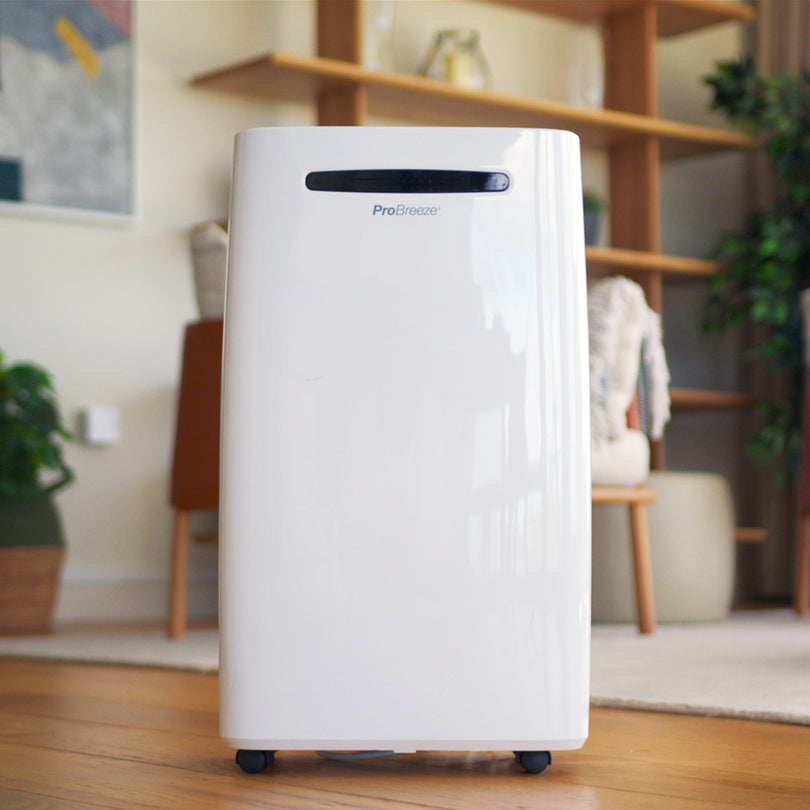
| 1200 Cu. Ft. Mini Dehumidifier | 33 dB | Up to 205 sq ft | 17 oz (500 ml) |
| 2200 Cu. Ft. Mini Dehumidifier | 35 dB | Up to 250 sq ft | 52 oz (1500 ml) |
| 52 Ounce Mini Dehumidifier | 35 dB | Up to 250 sq ft | 52 oz (1500 ml) |
| 50 Pint/Day Dehumidifier | 45–48 dB | Up to 2,000 sq ft | 1.8 gal (6.8 L) |
Decibel ratings and coverage estimates from Pro Breeze product specifications.
Browse our complete lineup on the Pro Breeze dehumidifiers page.
8How much does it cost to run overnight?
At the U.S. residential average of 18.16¢ per kWh (EIA, August 2026), compact dehumidifiers cost only a few cents for eight hours of operation at rated power:
| Model | Power draw | Cost per hour | 8-hour night |
|---|---|---|---|
| 1200 Cu. Ft. Mini Dehumidifier | 23 W | 0.4¢ | 3.3¢ |
| 2200 Cu. Ft. Mini Dehumidifier | 40 W | 0.7¢ | 5.8¢ |
| 50 Pint/Day Dehumidifier | 420 W | 7.6¢ | 61¢ |
| Typical Desiccant Unit | 620 W | 11.3¢ | 90¢ |
Calculated at 18.16¢/kWh (U.S. Energy Information Administration, August 2026). Units with an automatic humidistat cycle off once your target humidity is achieved, reducing actual overnight consumption.
For more detailed calculations, read our guide to how much a dehumidifier costs to run.
9Best Pro Breeze dehumidifiers for a bedroom

Compare models side by side in our full Pro Breeze dehumidifiers collection.
10Frequently asked questions
How do the timer and tank-full shut-off work?
The off timer switches the appliance off after the selected interval. Tank-full shut-off stops dehumidification when the tank needs emptying. Follow the instructions in your product’s manual for these controls and for where to plug in the appliance.
What humidity level should a bedroom be?
We recommend maintaining bedroom relative humidity between 30% and 50% (30–40% during freezing winter months). This prevents window condensation and stops dust mites and mold spores from colonizing bedding and carpets. For comprehensive allergy management, explore our guide to the benefits of an air purifier.
Is a Peltier mini dehumidifier quieter than a compressor model?
Yes, significantly. Peltier dehumidifiers use solid-state thermoelectric cooling modules with no moving compressor pistons, running at just 33–35 dB. They are whisper-quiet and generate zero mechanical vibration.
The best bedroom dehumidifier is one you barely notice: quiet, sized for your space, and set to maintain fresh, dry air between 30% and 50%. Explore our dehumidifier collection to find your model, or see our 13-step buying guide.


